
There isn’t a big fight. No one has packed a suitcase, and nobody is threatening to leave. If someone asked how your relationship was going, you’d probably say it was fine. That’s exactly what makes it difficult to explain. Something doesn’t feel right.
You still care about each other. You still make dinner, talk about schedules, and sit next to each other on the couch. But somewhere along the way, the relationship may have become more about managing life together than actually experiencing life together.
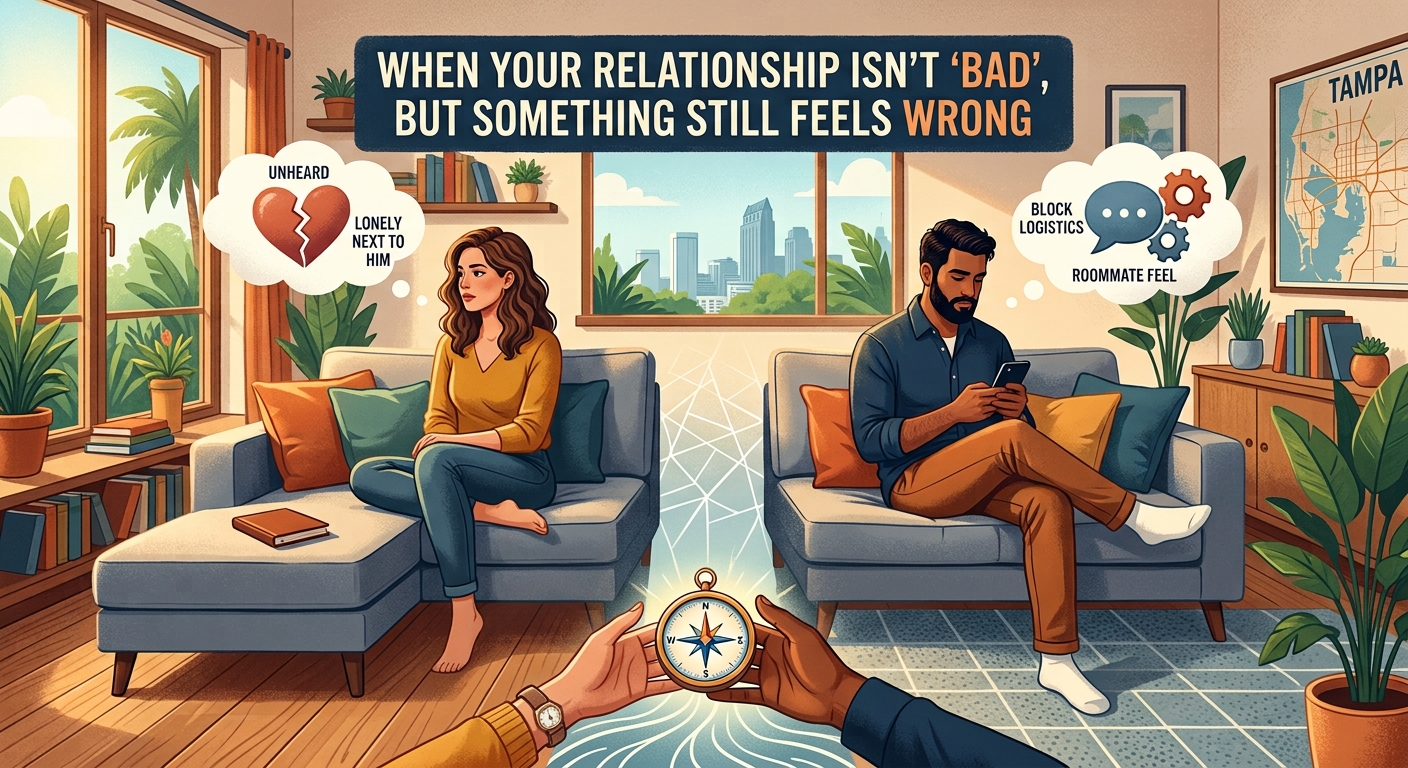
When You Become Roommates Instead of Partners
It happens gradually. First, you’re busy. Then work gets demanding, followed by children, appointments, errands, family obligations, and bills. You start communicating mostly about logistics. Who’s picking up dinner? Did you pay the electric bill? What time is soccer? Are you working Saturday? Eventually, you realize you can’t remember the last time you had a real conversation that wasn’t about something that needed to get done.
You’re not necessarily fighting. You’re simply disconnected.
Emotional Distance Doesn’t Always Look Dramatic
Emotional disconnection can be quiet. You may stop sharing things because you don’t think they’re worth bringing up. You might avoid difficult conversations, feel lonely while sitting next to your partner, or spend more time on your phone than talking to each other.
You may feel misunderstood, have the same argument repeatedly, or feel as though you’re carrying more of the relationship. You may simply miss the closeness you used to have.
None of these automatically mean a relationship is failing. Relationships change, people change and life changes. The question is whether you and your partner are changing together or slowly moving in different directions.
The Problem With Waiting for a Crisis
Many people think couples therapy is something you do when a relationship is on the verge of ending. It doesn’t have to be.
North Star Therapy offers couples therapy for communication difficulties, emotional disconnection, relationship stress and life transitions, as well as preventative couples work for partners who want to strengthen their relationship.
That can be important because relationships are often easier to work on when both people still have curiosity about each other. You don’t have to wait until every conversation becomes a fight.
Sometimes the Real Problem Isn’t the Argument
Couples often think they’re arguing about the dishes, money, sex, schedules or in-laws. Underneath the argument, however, there may be something else.
One partner may be thinking that they don’t feel appreciated, while the other may feel criticized or ignored. Someone may feel that they’re no longer a priority or that the two of them aren’t functioning as a team.
The surface problem can be small while the emotional meaning underneath it is much larger.
That’s one reason repeatedly trying to win an argument often doesn’t solve the problem. You may be arguing about the wrong thing.
Communication Isn’t Just Talking
Most couples communicate. The question is how.
One person may pursue the conversation while the other shuts down. One may become louder while the other becomes quieter. One person may want an answer immediately while the other needs time to process.
Eventually, both people can walk away feeling misunderstood.
Healthy communication involves more than simply talking. It also involves making time to connect, listening to your partner’s perspective and finding constructive ways to handle disagreements. The American Psychological Association provides guidance on healthy relationships and communication.
Improving communication isn’t necessarily about talking more. Sometimes it involves learning how to listen without immediately becoming defensive, expressing what you need without turning it into an accusation and recognizing the pattern the two of you have created together.
You Don’t Have to Blame Someone to Change Something
One of the useful ideas in couples therapy is that the goal isn’t necessarily to determine who the bad guy is.
The relationship itself becomes the focus.
Instead of approaching a conversation by saying that your partner never listens, you can begin looking at the pattern between you. Perhaps one person feels unheard and pushes harder, while the other feels criticized and withdraws. Each person’s response then reinforces the other’s behavior.
Changing that pattern requires both people to understand what they’re contributing to it.
Sometimes the Relationship Needs Attention Before It Needs Repair
You don’t need to be miserable to benefit from couples therapy. You may simply want to communicate better, prepare for marriage, navigate becoming parents, adjust after a move or reconnect after a difficult period.
You may also want to understand why two people who love each other don’t feel as close as they used to.
If your relationship has started feeling more like a partnership for managing responsibilities than a source of connection, couples therapy in Tampa can provide a structured space to slow down and work on what has been getting lost.
“We’re Fine” Isn’t Always the Same as “We’re Connected”
Maybe your relationship isn’t bad. Maybe that’s not the question. A more useful question may be whether you still feel connected to each other.
If the answer is that you don’t feel as connected as you used to, you don’t have to wait for things to get worse before doing something about it. Sometimes the strongest thing a couple can do is recognize that the relationship is okay but that they want it to be better than okay.