
You answer the emails, make the appointment, remember your child’s school project is due Friday, and somehow manage to get dinner on the table. You show up to work on time, meet the deadline, return the phone call, and keep moving through everything that’s expected of you.
If someone asked how you were doing, you’d probably say you’re fine. And technically, you are functioning. That’s what can make anxiety so difficult to recognize.
There is a common assumption that someone experiencing significant anxiety must look overwhelmed. Maybe they’re visibly nervous, unable to work, avoiding situations, or constantly talking about how stressed they are.
But anxiety doesn’t always look that way. Sometimes it looks like being extremely responsible, prepared for every possible problem, and determined not to let anything fall through the cracks. Sometimes it looks like success.
When Being Capable Becomes Part of the Problem
People who experience what is commonly called high-functioning anxiety may be very good at keeping things moving. They may be dependable, ambitious, organized, and highly conscientious.
Those qualities aren’t problems in themselves. The difficulty comes when the ability to keep functioning becomes a reason to ignore what’s happening internally.
You might think that because you’re getting everything done, you shouldn’t be this stressed. You may tell yourself that other people have it worse or that you’ll relax once the current project is finished.
But another project starts, another appointment needs to be made, another family obligation appears, and another bill needs to be paid. There is always something else.
Over time, anxiety can become less like an occasional feeling and more like the background noise of everyday life.
The National Institute of Mental Health explains that anxiety disorders involve more than ordinary, occasional worry. Persistent anxiety can interfere with daily life and may involve difficulty controlling worry, feeling restless or on edge, difficulty concentrating, fatigue, and problems with sleep.
You don’t have to fall apart for anxiety to deserve attention.
What High-Functioning Anxiety Can Look Like
There isn’t a formal diagnosis called “high-functioning anxiety.” It’s a term people often use to describe someone who experiences significant anxiety while continuing to meet their responsibilities.
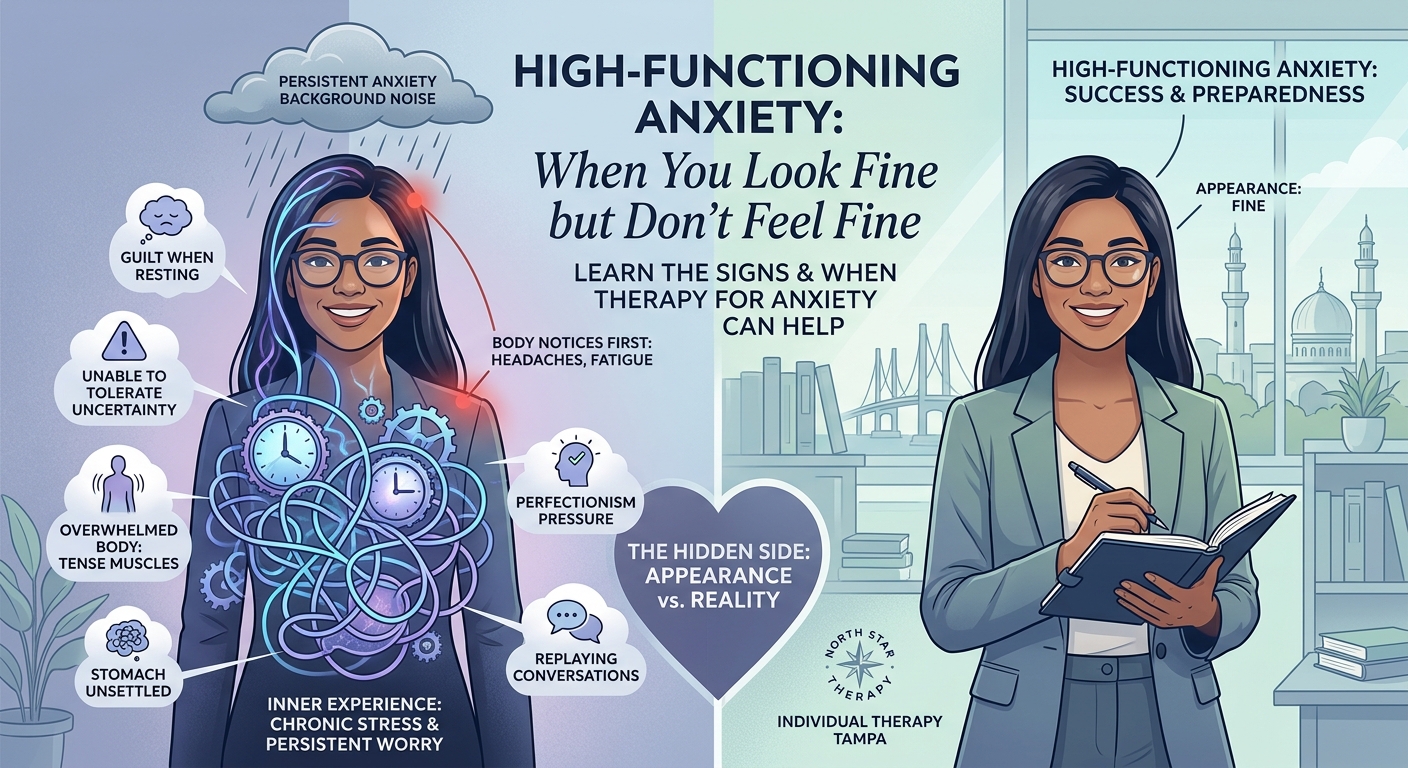
That can make the signs surprisingly easy to overlook. You might constantly think about what could go wrong, have trouble relaxing even when you have nothing you need to do, repeatedly check your work because you’re afraid of making a mistake, or feel guilty when you’re resting.
You might also say yes because you’re afraid of disappointing someone, replay conversations after they happen, struggle to sleep because your mind won’t slow down or feel physically tense much of the time. Planning everything in advance may help you feel more comfortable, while unexpected changes can create a disproportionate amount of stress.
You may accomplish a great deal while rarely feeling satisfied with what you’ve done.
From the outside, these behaviors can look like ambition or conscientiousness. Inside, they can feel exhausting.
The Problem With Always Being “The Responsible One”
There’s a particular kind of pressure that comes from being the person everyone trusts. You’re the one who remembers, handles things, and rarely needs help.
Eventually, people may begin to assume that you don’t need help because you’ve trained everyone, including yourself, to believe that you can handle everything.
That doesn’t mean you’ve done anything wrong. Being capable is a strength. The question is whether you’re able to be capable without constantly being on high alert.
There is a difference between caring about doing a good job and feeling as though something terrible will happen if you don’t do everything perfectly. There is also a difference between being prepared and feeling unable to tolerate uncertainty.
When Your Body Notices Before You Do
Sometimes the first indication that something isn’t working isn’t an emotional realization. It’s your body.
Maybe you’re exhausted even after sleeping, your shoulders are always tight, or your stomach is frequently unsettled. Perhaps you’re lying in bed at night reviewing tomorrow’s schedule, or you’ve started experiencing headaches.
Anxiety can have physical effects, and persistent worry can affect sleep, concentration, and energy. You might keep telling yourself that you’re simply busy, but if your body never seems to get the message that it’s safe to slow down, it may be worth paying attention.
You Don’t Have to Wait Until You Can’t Function
One of the biggest misconceptions about therapy is that you need to be in crisis before you seek it. You don’t.
Therapy can be useful precisely because you are functioning, but you’re tired of functioning this way.
At North Star Therapy, individual therapy in Tampa can provide a place to look at patterns of anxiety, stress, perfectionism, burnout, and overwhelm without having to prove that things are “bad enough.”
The goal isn’t necessarily to turn you into someone who never worries. Life comes with uncertainty. Work can be stressful, families have problems, and plans change.
The goal is to develop a healthier relationship with those experiences so that worry doesn’t have to run your entire day.
What Might Change When You Stop Treating Anxiety as a Personality Trait?
You may begin to notice that you don’t have to answer every message immediately. You can make a mistake without spending the rest of the day replaying it. You can say no without writing a long explanation. You can rest without earning it first.
You can care about other people without taking responsibility for everyone’s emotions.
Perhaps most importantly, you can begin to separate who you are from what anxiety has taught you to do.
Being organized isn’t anxiety. Being successful isn’t anxiety. Being responsible isn’t anxiety. But when those qualities become ways of avoiding uncertainty, criticism, disappointment, or failure, they may be worth exploring.
You Can Look Fine and Still Need Support
Maybe you’ve spent years being the person who has it together, and perhaps that’s even part of your identity. You don’t have to give that up.
You simply don’t have to carry everything quite so tightly.
If you recognize yourself in this story and you’re tired of constantly feeling like you have to stay one step ahead of everything, talking with a therapist can be a place to start. You don’t have to wait until your life falls apart to ask for help.
Sometimes therapy begins by acknowledging that although you look like you’re doing fine, you don’t actually feel fine. That’s enough to start a conversation.